Sunday, November 8, 2009

Line Drawings

Finally. After getting sick and getting way behind, I'm nearly caught up with my classroom work. I've finally finished scanning the last of our line art drawings and have posted them on the web.

I love teaching art. I enjoy finding projects and seeing what the kids will do with the ideas. The first project we worked on this school year was line drawings based on art projects I saw on the excellent blog: Deep Sparkle. The drawings were actually finished about a month ago but I just finished scanning the last of the drawings. As I said in my last blog, getting sick put me way behind.

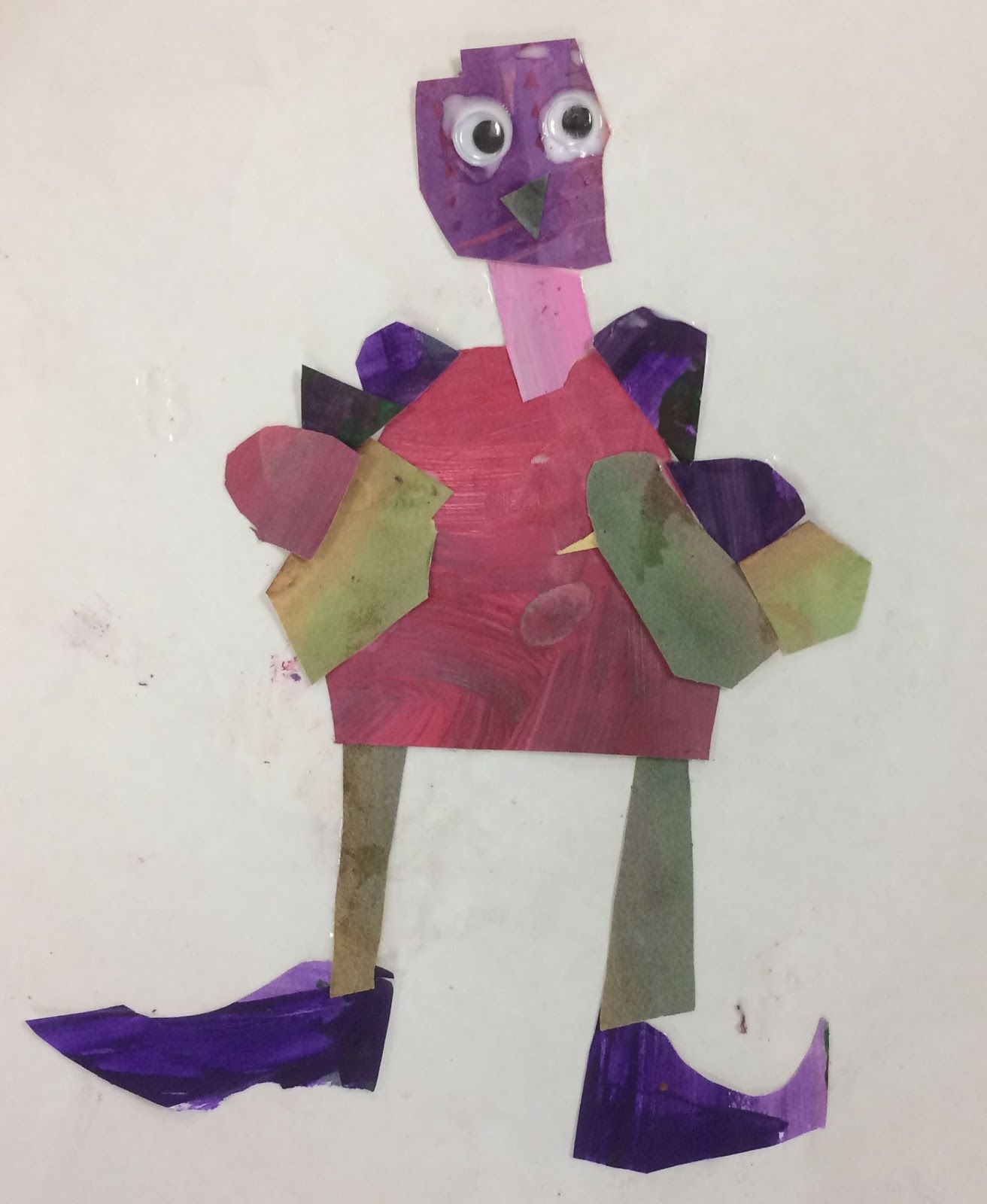
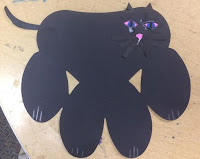
Line drawings are a good way to introduce and reinforce line and shape concepts. Through this activity, children learn a lot about the different types of line and shape, engage in planning, outlining, cutting and pasting, and mounting their projects. I followed the steps from Deep Sparkle's Turtle Drawings and Owls and Cats. All the project characters are modeled after these three ideas. You can see some student artwork here.

I modeled the outlines of each character for each grade level. I demonstrated how to create sections for each character and then together we brainstormed the many different line and shape types (geometric, organic, and free form). We make a huge chart of all possible lines and shapes we could use in our drawing. Students first drew with pencils and then outlined with thin Sharpie markers. All lines and shapes were drawn with markers only. Each section has to have the same line or shape within.

As with any art project/activity, this one touches on many of the art standards required by my State of Washington. When I return the art work to homeroom teachers, I try to include a list of those standards that were addressed. I include them here for those of you who might be interested. The project models below are teacher models.

1st grade turtles: Identifies and produces types of lines to create direction. Uses and produces horizontal, vertical, diagonal, curved, dotted, dashed, and zigzag lines to create shapes in an artwork.


2nd grade fish: Uses and produces different line qualities for a
variety of purposes. Uses and produces horizontal, vertical, diagonal, curved, dotted, dashed, and zigzag lines to create shapes in an artwork.


3rd grade cats: Produces different line types and line qualities to create detail in artwork. Uses and produces horizontal, vertical, diagonal, curved, zig-zag lines to create images. Uses lines to create patterns, designs, and textures in art.


4th grade owls: Produces different line types and line qualities to create detail in art work. Uses and produces horizontal, diagonal, curved, zig-zag lines to create a picture. Uses patterns, designs and textures and textures in art work.


5th grade: Produces different line types and line qualities to create detail in art work. Uses and produces horizontal, diagonal, curved, zig-zag, dashed, dotted, thick/thin lines to create a picture. Uses patterns, designs and textures and textures in art work.

Saturday, October 24, 2009

This the season to get sick.

We've finished our line drawings and I can't wait to finish scanning them and posting some examples. I encountered a bit of an interruption: the flu. Kids in my school are dropping like flies. Recently, one of my art classes had only 8 students. And even though I wash my hands constantly, the germs found me and knocked me off my feet. I missed about a week of school and am just now getting my full strength back. Oh the joys of teaching.

In the past two weeks the kids have been engaged in various activities in centers I've set up. Around Halloween I set up some drawing activities I call "Drawing with Ed Emberly." Emberly has some excellent step by step drawing books that are centered on the Halloween theme. The kids draw bats and cats, ghosts and goblins, skeletons, haunted houses and many other spooky things.

Another center is really quite simple. I drew some Halloween pictures on 9x12 tag board and then traced the lines using glue. After the glue dried, they made excellent crayon rubbings. I have rubbings for ghosts and bats and pumpkins and cats (and others). I use this activity to expose the kids to the effects of using complimentary colors. I instruct students to choose a color for the rubbing (using crayon), and then using the color chart, find the colors complimentary color for the paint wash. It's pretty simple and they won't win an art award. But the kids have fun and it gives me another opportunity to talk about the color wheel.

I also set up two tables for painting where kids can free paint (painting whatever they like just for the fun of painting!) or they can choose the crayon rubbing activity. Also, I provide orange construction paper and have step by step instructions for drawing Bert and Ernie pumpkins. Other students use the Orange paper and draw a large pumpkin on it.

When I set up the clay center it's always a big hit. I usually need two tables for clay (non-drying kind) and just let the kids create. We have a display table with the following rule: When I need more clay, the older clay forms on display get "smashed." I try to take pictures of all the creations and run a slide-show of all the work the following week. The kids always love this part.

I'm always glad when the Halloween season is over with. The kids are always a bit pumped up during this time and the final few days before Halloween can be very challenging. During this crazy time of year I focus mainly on routine (how to manage oneself during center time for example). I do however manage to slip in some skill/concept teaching when their not looking. ;)

Friday, September 18, 2009

Now that school is well under way......

I'm ready to begin posting again and sharing some of the ideas I'm using in my classroom. For the past two weeks, my students have been busy finishing up work on their portfolios/folders. In past years I began the year teaching Ed Emberly's drawing alphabet, Monarts family of shapes, and Mark Kistler's Draw Squad concepts. I will still cover these drawing ideas with my students, but this year my approach will differ. I'll begin the year focusing on the elements and the principles of design. For the next few weeks I'll be introducing and reviewing the elements of design with all classes. I plan to focus on line and shape first, and then introduce and focus on the other elements (the principles) as the weeks progress. Then it simply becomes a matter of repetition and reinforcement and encouraging a class culture that builds on this knowledge through meaningful creative experiences.

I also want to experiment with TAB (Teaching for Artistic Behaviors). I have some ideas for my first centers (based on line, shape, and color) and my plan is to spend a few weeks teaching with direct instruction and guided practice, and then designing centers where students can make choices and creatively interact with the art ideas previously presented.

I still want to teach many whole group projects as they are proven favorites and offer unique art experiences (such as painting with colored chalk, getting interesting textual effects using cellophane among others). Clearly, there is more than one effective instructional method. I've been very successful teaching art using the teacher directed method. And once a set of skills and procedures has been learned and practiced, I've let the kids go and create using their own ideas. (I call those open-ended activities "Free Draw" or "Free Paint" activities. It simply allows for students to either draw or paint things that are of interest to them. I have a set of "Free Draw" books - step-by-step - that children use for drawing. Free Painting is usually a time where kids just paint for painting's sake.)

This year I'm going to try to design some centers that will follow a series of direct teaching experiences. The centers will build upon the concepts taught in the whole group lessons and allow for students to experiment with the ideas they recently learned. My room is pretty small so I'm not sure how well this will work. I have one sink, and 5 tables. There is very little room to "squeeze" around the room but it's doable. Picture a room that has 5 tables and one supply area. That's all the room I have to work with and it's part of the reason I've been reluctant to do centers in the past. As I find out what works and what doesn't, I'm sure things will change a bit and I'll work out the wrinkles. Wish me luck.

In addition to blogging about my experiences with these ideas, I have developed a website to host student's work. In addition to sharing things I'm doing this year, I hope to continually add ideas that I've used and found successful in the past.

Thursday, August 27, 2009

Teaching with Love and Logic

Today was my first day back at work. We had one of those "Teacher Training" days and I always find the time we spend together as a staff to be both exciting and motivating. In the morning we had a brief meeting, and then, in teams, we hopped into our cars and went on our first grade home visits. Each incoming first grader is visited by a team of teachers, given a small packet containing a book to read, information about school and upcoming events, and a few other items that would interest a child of that age. After that we had lunch and then spent the remaining afternoon with a refresher course on the Teaching with Love and Logic principles.

When I was first introduced to the Love and Logic principles, I was immediately attracted to its simplicity and sensible approach to classroom management. Although there is much that could be said about Love and Logic philosophy, I believe they are encapsulated in the four following principles.

1. Build Relationships: The most powerful thing a teacher can do to effectively manage his or her classroom is to build a meaningful relationship with each student. Get to know their names quickly. Learn something about each student. Notice them and acknowledge. Greet them each day (meet them at your door). Smile. Be sincere. Ask them questions about things that they might find interesting. Use positive body language including safe and gentle touch (side hugs with younger students, high fives, other appropriate touch with older students). With the older boys, I like to give the shoulder bump (like the football players do except I do it softly). Show interest in your students.

2. Show Empathy: We all make mistakes. When a child is frustrated, or hurt, show empathy for the child by acknowledging their feelings. Saying things like, "That must be frustrating." or "You look upset." or "Ouch, that must hurt." shows students you care about how they feel. These are statements of empathy. Say a child is running through the hall and slips and skins his knee. Rather than say, "That's why we walk in the hall." you could say, "Looks like you skinned your knee. That must hurt. Let's go to the nurse and have her take a look at it." Then later, after the child has had time to consider the consequences of his actions (running in the hall) you might say, "How's is your knee doing?" (show empathy) "Have you thought about what you could do differently so that you don't get hurt again?" Most kids have already figured that out.

3. Offer Choices: When a child is acting up and you want the behavior changed, give reasonable choices. Keeping the principle of empathy in mind, acknowledge that the student looks frustrated (or mad) if appropriate. If the student is just acting out, ask if they can pull it together of do they need to go to the back of the room (or across the hall) and pull it together there. Make the choices reasonable and non threatening. (In Love and Logic, you don't always have to give choices. If a strong relationship has been formed, that alone may give you enough of a bond between you and that student to ask for compliance. "Do that for me will you? Thanks." Turn and walk away - assume the student will comply. Most often, they will.

4. Use Enforceable Statements: An enforceable statement is one that you can actually enforce. It's what you will do, not what you expect the students to do. For example, "Turn in your math books to page 14 and look at problem one. We'll start there. I'll begin the lesson in thirty seconds." When the thirty seconds is up, begin the lesson and notice those students that haven't followed through. Walk toward them but continue teaching. As you approach them, most students will magically find page 14 and get on task. The enforceable statement, the one in italics, is one you can enforce. Be sure not to say it unless you can actually do it. Always follow through.

Love and Logic principles also include the ideas of avoiding getting sucked into arguments with kids, delaying consequences until you've had time to reflect what's appropriate for the situation (which also give the students plenty of "think time), and a plethora of other great ideas on relating and dealing with students in one's classroom. The above are really small snippets of a much larger picture. If these ideas are of interest to you, find out more by visiting the Love and Logic website.

Happy Teaching.

Wednesday, August 26, 2009

Student folders

When the school year begins, it's time to get to know the students, set the boundaries, establish routines, and find that assignment to start the year off right. Since I only see my students every 6 days (counting weekends) and only for 45 minute periods, time is a precious commodity. When the students show up on their first day with me, I get right to work. Boundaries, routines, expectations, and "getting to know you" engagements can all be done in the first few class meetings. I go over boundaries and routines etc as the opportunities arise. Brain reserach tell us that students can handle information in small doses and not in large chunks. So I introduce only those routines that are necessary for that day.

The first assignment is simple" Students are given an 12 X 18 piece of white construction paper. They are told to fold the paper in half and on what would be the front, students place their name (first and last) and the teacher's name on the bottom of the front cover. Then they are to place the words "Fine Arts" somewhere on the folder (I suggest the top but it's only a suggestion.) Then they are instructed to illustrate the folder any way they want. I show some examples, offer some ideas and themes, and give them a time limit (must be completed by the second day of class).

I start day one with my "seven minute rule." I've written on this elsewhere on this blog but I'll briefly repeat it here. I use a timer, projected on the overhead screen, and expect the students to work for a full seven minutes with no talking. When the seven minutes is up, I set the timer to three minutes and allow students to use one of those minutes to stretch and rest their hand (and head) and then to continue to work but quiet talking and sharing is allowed. After the three minutes is up, I repeat the process. First, seven minutes of quiet work, followed by three minutes of a more relaxed time. Also, toward the end of the class time, I allow for quiet talking and encourage the sharing of work.

You thoughts? Here are a few examples of student folders. The images aren't the best but they will give you the idea.


Art Folders and assessment philosophy.

In my previous post I wrote the following concerning assessing the arts:

How does one measure attitudes, self-confidence, self-discipline, a sense of accomplishment, or the development of a student’s neurobiological system? A highly structured arts program complete with a highly structured assessment can’t accurately measure these things. And if the arts are highly structured, there is a danger that individual expression may diminish or be completely lost. Many students will turn off to the arts. This is the exact opposite of what we want to accomplish through the arts.

(I should say from the start that I'm really talking about the report card grades here and not the grades of each individual assignment. While I do grade some assignments, I only do so for my own personal record keeping. I'm more interested in celebrating work accomplished and hearing what students says about their own work, what they like about their work, why they chose the colors they chose, or whatever their thoughts are when reflecting on completed work. In my view, at least at the elementary level, the worst thing to do is to grade each piece of work. Some students already have the "I can't do it" attitude and it seems to me that assigning grades to each assignment would only reinforce that attitude in some students.)

I've always struggled with assessments in visual arts. I don't like attaching a "grade" to a child's artwork. I'd rather simply grade according to a student's attendance and class participation. In my view, the skills students possess in the arts aren't as important as their level of engagement. If, for example, a gifted student slacks off, but produces work that is above that of his/her peers, in most systems they could still get a good grade. Conversely, a student who is fully engaged in the art assignments, displays a positive attitude, but lacks the skills to produce exemplary work, might not receive a good grade, despite the hard work. But which is a more important attribute: natural skill or a good work ethic and positive attitude?

I don't have the luxury of using the “pass/fail” approach that Jensen's suggests as a better way to assess the arts. In the system I must use, the grading is on a scale of 1-4. A "3" is given if the student is meeting the State standards for that grade level.

Using this system for recording grades, my approach is very simple. During the first two class meetings I have the students take an 11x17 piece of white construction paper, fold it in half, and use that "folder" to put all their class assignments and sketches in. I try to do a quick assessment of each child's work as they are completing each project. I do this during class. I also review their folder work and do a quick visual assessment of their work.

There are a few specifics I am looking for when assigning a grade. Did the student complete the assignments and exercises in class? How well did they follow the instructions given? Did the student demonstrate a level of understanding of the concepts being learned? I try to follow Jensen's suggestions for the "pass/fail" approach even though I'm giving a numerical grade.

The criteria for pass/fail are simple, straightforward and reachable by all students. Students must have good attendance in class, participate in the class activities, develop a portfolio of their work, get portfolio feedback via peer sharing as well as other ideas listed by Jensen, and participate in a student/teacher conference.

A portfolio of a student's work (or "Folder" as I refer to it) will tell you something of a student's attendance - missing assignment pieces is likely due to an absence (I don't keep records of attendance as it is just one more thing to track) and certainly will tell you their participation level in class. The portfolio, along with class observations, will give you enough information to assign fair grades.

One drawback to the numerical grading system is that nasty little "skills and concepts" box. Some students clearly are above the line, and some below. Where students clearly fall below the line, I grade accordingly. Where students clearly rise above it, I grade accordingly. I rarely give out "4's" or "2's" except where it's completely clear that under "skills and concepts," that's what the student deserves. Visually, the 1 - 4 grading continuum looks like this in my mind:

1-1//2---2//3-------------------------------------3// 4---4

All points on the grading scale are not equal in my view. Most students will fall under the "3" as it is the largest area. Few fall under the "2" (below grade level) or "4" (above grade level) and even fewer under the "1." To get a "1" in my class you'd have to show up and do nothing (and I've had a few students like that!).

I hope someday that the grading for the arts will more accurately reflect the long term goals of the arts and not simply reflect some need for accountability. Until then, this is the system I use, flawed as it is. In review, Jensen offers these three ideas to include in assessing the visual arts:

1 Have good attendance in class

2 Appropriate participation in the class activities

3 Develop a portfolio of their work and get portfolio feedback (from peers and instructor)

As always, I would love to hear your ideas on the thoughts I've presented.

Friday, August 14, 2009

Assessments

Jensen states several times throughout the book that the arts are not “efficient.” He means that the benefits are not immediate – they are seen in the long term. Art is a creative process. It’s a personal experience and it’s a meaningful way the artist can express him/herself. The arts help in the development of the brain and the benefits to our brain development happen over time. How does one measure attitudes, self-confidence, self-discipline, a sense of accomplishment, or the development of a student’s neurobiological system? A highly structured arts program complete with a highly structured assessment can’t accurately measure these things. And if the arts are highly structured, there is a danger that individual expression may diminish or be completely lost. Many students will turn off to the arts. This is the exact opposite of what we want to accomplish through the arts.

Assessing creativity poses many problems. Creativity is highly individual. To focus on the grading of artwork is, as Jensen states, to devalue learning and minimize creative expression – the very things we want to enhance in our students. If students think they have to “pass a test” on say a particular drawing or painting or musical composition, they will focus on the wants of the teacher and not on their individual form of expression. Students will care more about what their teacher thinks of their work than focus on the sheer joy of the art experience itself. After all, that is a huge goal of the arts: the joy of personal expression through various art forms.

Jensen proposes a better way of assessing the arts through a “pass/fail” approach. The criteria for pass/fail are simple, straightforward and reachable by all students. Students must have good attendance in class, participate in the class activities, develop a portfolio of their work, get portfolio feedback via peer sharing as well as other ideas listed by Jensen, and participate in a student/teacher conference. Such an approach allows the student to reflect upon his/her work and helps created an atmosphere of trust and artistic freedom that encourages individualism in each artist. Reviewing a portfolio with students is also a way to celebrate the student’s work.

After reading this chapter, I believe I have been on the right track with respect to assessment in the visual arts. There are some weak areas that I need to address but overall I find myself applauding Jensen’s ideas.

I’ve always had students make a portfolio that contains samples of their work. But I don’t think I carry this idea far enough and would like to follow more closely Jensen’s suggestions. For one, I’d like to give students more say in what goes into their portfolio. And, since I have over 400 students, I’d need to figure out an efficient way to hold some student/teacher conferences – I see great value in having them but am not sure how to manage the logistics with so many students. I'd like to offer more time for students to share their portfolio work with their peers not only get valuable feedback of their own work, but to learn from the ideas of others.

I’ve always resisted any formal assessments in the visual arts. Observing my students while they are working, and viewing the work in their portfolios gives me some idea of their skill levels and more importantly, their commitment level to the class art activities. An added step would be conferencing with students about their work.

I’ve participated in art shows before, but never had one of my own. I’m thinking of exploring this idea with the music teacher and see if we can come up with an idea for an art night. The music teacher has a group of choir and mallet musicians and together with visual art displays, we could make a fun and informative night for parents and students where they get a chance to share and celebrate in the student’s work.

A final note: I’ve asked my principal to read this book over the summer. Perhaps there isn't enough of an emphasis in the arts in schools. Individual classroom teachers either feel the art specialist covers the art needs for their students, or there simply isn’t enough time for them to do art, or they don’t feel competent in the area of art. Considering that administrators often claim over and over that teaching should reflect current research, it seems that we ought to be putting some of our staff training time into the area of arts considering its value. We spend most of our time learning about reading and math or science. In my ten years as an art teacher, I don’t think we’ve ever had even one art in-service day. Maybe I can help to change that.

Final note: with this post, my series on Jensen's book ends. I'm currently reading his book, "Teaching With The Brain In Mind" and perhaps I'll share some of my reflections when I'm done.

My next series of blogs will offer up some of the ideas I've used in the classroom. I hope you will stay tuned and that you will find some ideas you can use in your own classroom.

Dan